New Blog PostPodcast Marketing: Grow a Professional Show After Launch
Podcast Marketing: Grow a Professional Show After Launch
Most business podcasts get a burst of attention at launch and then plateau. The first episode lands, internal teams share it, and early downloads look promising. But a few episodes later, growth stalls. The problem is rarely content quality. It is almost always a marketing gap.
This page covers what podcast marketing looks like after the launch phase, how to grow a qualified audience over time, and when managed support makes the difference between a show that compounds in value and one that quietly fades.
What podcast marketing should achieve
This guide updates Masterly Podcasts' existing podcast strategy and growth service specifically for teams with a show that has been live for three to six months or longer. If your show is already publishing, the work shifts from "get it launched" to "make it grow in the right direction."
Podcast marketing in business terms means growing qualified listeners, feeding your sales pipeline and recruiting efforts, and strengthening brand trust. It is not about chasing download spikes or vanity metrics. Podcasts allow for personal and authentic brand communication, which is why they work well for executives and organizations that need to build credibility with a specific audience.
There is a meaningful difference between launch marketing and ongoing podcast promotion. Launch marketing is a burst: announcements, guest posts, press outreach, internal excitement. Ongoing podcast promotion services involve sustained work across metadata, clips, distribution, email, cross-promotion, and measurement. Most shows that stall after launch are missing the second part entirely.
Executives should expect three core outcomes from a working podcast marketing strategy:
Audience growth among the right roles and accounts, not just total numbers
Better listener retention, meaning more followers, higher completion rates, and return listeners
More listener-driven opportunities: inbound deals, speaking invitations, hiring leads, and partner connections
Mature shows need to balance fresh discovery with re-engagement of existing listeners. New listeners come through search, social clips, cross-promotion, and platform features. Existing listeners stay through email roundups, evergreen content replays, and consistent publishing. Both matter, and a strong podcast marketing plan addresses both.
One advantage worth noting: podcast episodes remain discoverable long after publication, unlike social posts that decay in hours. And because listeners actively choose to tune into podcasts, the format reduces ad fatigue compared to interruptive channels. Word-of-mouth remains crucial for podcast growth, especially among niche professional audiences.
Align podcast marketing with business goals
Before picking channels or tactics, tie your podcast marketing strategy to concrete business goals. This step prevents wasted effort and gives your team a clear filter for every decision.
Common goals for B2B and executive podcasts include:
Pipeline influence: generating leads or contributing to deal acceleration through relevant conversations and case studies
Account-based awareness: building recognition among specific companies or decision-makers in target verticals
Partner ecosystem reach: strengthening credibility among collaborators, vendors, or channel partners
Employer brand and recruiting: showcasing culture, leadership, and values to attract talent
Different goals shape the podcast marketing mix. If pipeline influence is primary, you might emphasize guesting on shows where your target audience already listens, promoting case-study episodes, and enabling sales to share personalized episode links. If account-based awareness drives the show, LinkedIn posts tailored to specific accounts and 1:1 sharing with target decision-makers take priority over broad social reach.
A simple "podcast growth brief" helps crystallize priorities. Define your target audience personas (roles, industries, topics of interest), ideal accounts, and internal stakeholders such as sales, HR, and leadership. Success is measured using KPIs like downloads and engagement, but those KPIs should map back to the goals you define here.
Masterly's managed plans start with a workshop to align audience, show positioning, and marketing priorities before any tactics roll out.
Episode packaging and discovery
People discover podcasts one episode at a time, through listening apps, Google search, social feeds, and shared links. Packaging matters as much as production because the episode is the first thing a potential listener evaluates.
Episode packaging includes episode titles, episode descriptions, cover images, series naming, and episode-level CTAs. Each element either invites someone to press play or lets them scroll past.
Create compelling episode titles to boost download numbers. Vague titles like "Episode 14" or "Leadership Chat" give a listener no reason to click. Specific, searchable episode titles that promise a clear outcome perform better: "How CFOs in Manufacturing Reduce Reporting Cycles" tells a listener exactly what they will get. SEO-friendly episode titles boost overall download numbers because they surface in both app searches and Google results.
Use keywords your buyers actually type into Google or Apple Podcasts, but avoid turning titles into keyword-stuffed headlines. The goal is clarity and relevance. If your potential listeners search for "podcast marketing strategy for B2B," a title reflecting that language will outperform a clever but opaque phrase.
Avoid teaser traps in promotional materials and titles. Clickbait erodes trust, especially with executive audiences who value their time.
Masterly reviews past episodes, creates a title and description framework, and trains internal hosts and producers on consistent naming conventions that support both discoverability and brand perception.
Episode metadata that helps people (and platforms) find you
Metadata is the information that podcast apps, search engines, and directories use to categorize and surface your show. Getting it right is a practical, slightly technical task that has outsized impact on discovery.
Key metadata fields include:
Show title
Show description
Episode titles and episode descriptions
Categories and subcategories
Author fields
Links in show notes
Thoughtful episode descriptions matter because the first one to two lines appear in preview snippets across Apple Podcasts, Spotify, and Google search results. Lead with a hook and a clear value statement, not generic filler. Apple Podcasts requires metadata updates via RSS feed, and changes typically appear within 24 hours.
Strategically optimize podcast directory entries with keyword-rich titles and descriptions that match what your audience searches for. Optimize show notes with keywords for better search engine visibility. Show notes can serve as standalone content for SEO when structured properly.
A repeatable structure for show notes works well:
2–3 sentence summary of the episode
3–5 bullet takeaways or value points (for people skimming)
Timestamps for key topics
Resources mentioned in the episode
A single, clear CTA (subscribe, download a resource, contact)
Part of Masterly's managed podcast marketing service includes auditing and rewriting legacy metadata for back catalogs, then standardizing a style guide so every new episode follows the same framework.
Distribution and platform fit
Being "everywhere" does not mean promoting everywhere. It starts with correct distribution to major listening platforms and a central podcast website hub that you control.
Core platforms most professional shows should cover in 2026:
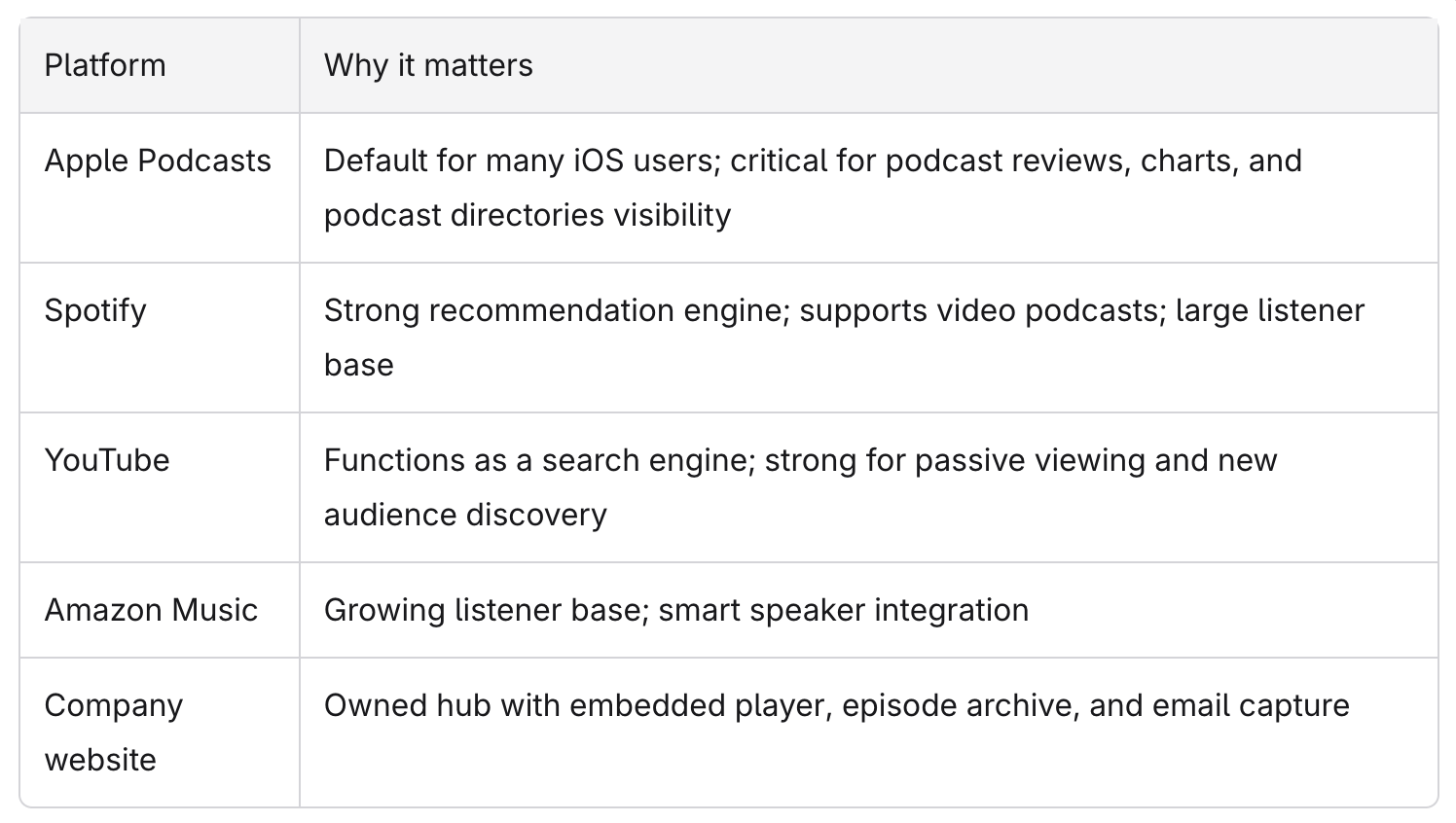
Submit your podcast to major platforms like Apple Podcasts and Spotify as a baseline. Platform behavior differs: Apple Podcasts remains the default listening app for many users, Spotify's algorithm surfaces recommendations to new listeners, and YouTube's search plays a major role in how people discover podcasts through video and audio content.
A dedicated podcast page on your company site with an embedded player, episode archive, and links to subscribe on major apps gives you a solid foundation you fully control. This is where you collect emails, host transcripts, and drive SEO traffic.
Masterly handles initial distribution set-up, ongoing RSS feed health, and optimization for each platform as part of a managed growth plan.

Optimize for Apple Podcasts and other podcast apps
Apple Podcasts still matters for rankings, reviews, and discovery. Many third-party podcast directories pull data from Apple's catalog, so optimization here ripples outward.
Concrete Apple Podcasts optimization steps:
Category selection: choose the most accurate category and subcategory for your content
Show description: make it compelling, stating who the show is for, what it covers, and why it exists
Cover art: square, visually clear at small thumbnail sizes, with consistent brand typography and color
Publishing cadence: consistent scheduling signals reliability to both listeners and algorithms
Ratings and reviews influence your podcast's attractiveness and listener trust more than they influence algorithmic ranking. Ask for podcast reviews naturally at the end of episodes ("if this was useful, a rating on Apple Podcasts helps others find us") without spammy or high-pressure CTAs. Subscriber count reflects the size of your loyal audience and is a metric worth tracking over time.
For other podcast apps like Overcast, Pocket Casts, and Podcast Addict, optimization happens through proper RSS feed data, not extra manual uploads. Ensure your RSS feed meets platform specifications for episode numbering, season tags, explicit content flags, and description formatting.
Masterly monitors analytics from Apple and Spotify dashboards to understand follower growth and listener behavior by episode, adjusting strategy based on what the data shows.
Repurposing clips into campaigns
One podcast episode can fuel weeks of podcast content if repurposed deliberately into clips, text, and visuals. Posting a single link and moving on wastes the majority of an episode's value.
A standard post-publish workflow looks like this:
Identify 3–7 short clips per episode during or after production
Pull key quotes for text-based posts and blog posts
Create short video clips with subtitles and headlines
Schedule assets across chosen channels over the following weeks
Creating short video clips and shareable graphics maximizes episode engagement. Short-form video content should be 30 to 60 seconds long, with dynamic captions to enhance engagement in video content since most social feeds play without sound.
The data supports this approach: 89% of podcast listeners watch clips on social platforms, and 84% say clips turned them into regular listeners. Video podcasts repurposed into Reels, Shorts, or TikToks generate roughly 4.6 times more total impressions than the full episode alone. Video content is more shareable on social media platforms, which makes repurposing a multiplier rather than busywork.
Repurposed content should be designed as "zero-click" posts: valuable and complete in the feed, with the podcast link as a soft next step. The clip itself delivers the insight. The full episode is there for people who want more.
Repurpose podcast content into multiple formats for broader reach. Beyond clips, consider creating blog posts from transcripts, pulling data for infographics, and turning guest quotes into visual assets. Masterly's team turns each published episode into a mini-campaign calendar, coordinating with internal marketing to avoid overlap with other launches.
Social media and audience growth
Social media is the most accessible podcast marketing channel, but it rewards the right approach and punishes laziness. For most B2B and executive shows, the right channels are LinkedIn, YouTube, and sometimes X.
Posting "new episode out now" is not an effective strategy. It tells potential listeners nothing about why they should care. Instead, lead with insight, a data point, a story, or a provocative quote from the episode. Create content that delivers value on social media even for people who never click the podcast link.
Formats worth testing:
LinkedIn posts with a specific takeaway and a question that invites discussion
Short clips with subtitles for LinkedIn and YouTube Shorts
Carousel posts summarizing 3–5 key points from an episode
Quote images featuring the guest or host
Visual platforms promote short-form video as a powerful discovery funnel for new listeners. Promote high-quality content consistently across social media platforms rather than in sporadic bursts tied only to publish dates.
Hosts and internal leaders should share episode clips and reflections on their personal profiles, not only from the company page. Personal profiles of executives often reach overlapping and niche decision-makers more credibly than a branded page. This is a natural extension of how people already use LinkedIn.
Use trackable links to measure social media effectiveness. UTM-tagged links tell you which posts actually generate more listeners, which formats drive clicks, and which channels are worth continued investment. Use social media to share valuable insights from your episodes, not just announcements.
Masterly can manage social assets, posting schedules, and performance reviews as part of managed podcast promotion services.
Internal communications and employee activation
Employees are often the largest ready-made distribution channel for a business podcast, but they are rarely given tools to share the show effectively.
Use internal communications channels like Slack, Microsoft Teams, intranet, and internal newsletters to announce key episodes and highlight employee guests. Frame episodes as resources employees can use with prospects, candidates, or partners. For example: "Send this conversation to your prospect before the next meeting" or "Share this with candidates during the hiring process."
Engaging with listeners through questions can foster community and loyalty, and this works internally too. When employees listen and discuss episodes, they become advocates. Turning employees into regular podcast listeners creates steady word-of-mouth audience growth without extra ad spend.
Masterly often coordinates simple share kits for sales, customer success, and recruiting teams with ready-made blurbs, graphics, and links for each episode, making it easy for anyone to share without crafting their own content.
Cross-promotion, guest amplification, and other podcasts
Cross-promotion means intentionally exposing your show to audiences already listening to other podcasts in your niche. It is a cost-effective growth tactic for podcasts and one of the most reliable ways to reach potential listeners who are already in the habit of listening.
Practical approaches:
Guesting on other podcasts: guest appearances can introduce your podcast to new audiences, and guest leverage can help reach established audiences in your niche
Promo swaps: promo swaps involve playing each other's trailers on episodes, giving both shows exposure to a warm audience
Episode feed drops: sharing a full episode in another show's feed as a preview
Joint episodes: panel-style recordings across multiple shows, or montage episodes that compile answers from multiple podcasters on a single topic
Collaborations with similar-size podcasters can enhance podcast visibility. Collaborating with other podcasters can share audiences effectively, and fit matters more than size. A smaller show with high overlap among your target decision-makers is more valuable than a large generic show with no relevance. Focus on overlapping roles and topics rather than raw subscriber counts when choosing other podcasters to cross promote with.
Guest amplification is a specific tactic: after recording, provide each podcast guest with a media kit including clips, images, suggested copy, and a schedule so it is easy for them to share the episode widely. Most guests want to promote their appearance but lack the assets to do it quickly.
Masterly helps identify peer and partner shows, craft pitches, and manage recurring cross-promotion opportunities over a season.

Email marketing and owned channels
Email marketing is one of the most controllable levers for turning casual podcast listeners into subscribers and customers. Unlike social algorithms, you own your email list and control when your audience sees your content.
Integrate podcast episodes into existing company newsletters with short insights, quotes, or a related story instead of just "listen now" buttons. People are more likely to click when you give them a reason beyond the episode existing. Building an email list fosters a direct connection with your audience that no algorithm change can take away.
Collect emails from listeners via the podcast website by offering episode deep-dive notes, bonus content, or transcript access. This builds a segment of known subscribers you can re-engage directly.
Send periodic round-ups such as "Best episodes for CFOs in 2026" to re-engage lapsed listeners and highlight evergreen content. These work especially well because podcast episodes remain valuable and searchable long after publication. Regularly release episodes to build audience trust and loyalty, and use email to remind your own audience that new episodes are available.
Masterly's plans can include planning email content around major podcast themes so marketing teams do not have to manage yet another content stream alone.
SEO, Google Search, and episode discoverability
Podcast SEO means making your episodes discoverable in Google search as well as inside podcast apps. Google started indexing audio files in 2019, and since then the connection between podcast content and organic search has only strengthened.
Every significant episode should have its own episode page on the website, with a descriptive H1, meta description, and structured show notes. This page becomes the canonical destination for search engines and for anyone sharing the episode link.
Creating transcripts for episodes can support accessibility and searchability. Transcripts improve podcast discoverability in search engines by giving crawlers text that reflects real listener language. Edit transcripts for clarity, divide them into scannable sections with headings, and include timestamps. Using the Yoast SEO plugin helps optimize podcast show notes if your site runs on WordPress.
Episode titles and headings should reflect the questions your buyers actually ask. If someone searches "how to use a podcast in internal communications" or "podcast marketing strategy for B2B," your episode page should match that language naturally. Think in terms of buyer questions, not internal jargon.
Masterly builds a repeatable episode SEO checklist and coordinates with internal web teams to ensure each new episode page is optimized and tracked. This includes keyword research, heading structure, internal linking across episodes, and monitoring performance in search engines over time.
Paid promotion without wasting budget
Paid promotion is an accelerator for shows that already have a clear audience and message. It is not a fix for a weak concept or poor positioning. If your podcast content does not retain the listeners you have, ads will not solve the problem.
A few high-intent paid options worth considering:
Podcast app placements: Apple Podcasts and Spotify promotions where available, or sponsorships within other shows
Targeted LinkedIn campaigns: effective for promoting episodes to specific titles, industries, or accounts
Industry newsletters: sponsorships in newsletters whose subscribers match your listener personas
There is a difference between running podcast ads for single episodes versus always-on campaigns promoting the show as a whole. Single-episode promotion works for flagship content with a high-value guest or topic. Always-on campaigns build steady awareness and are better for long-term audience growth.
Podcast ads deliver a 4.2x return on investment when campaigns are well-targeted. In one case, a national home furnishings retailer saw a 23% lift in purchase conversions and a 24.9% lift in store location searches after a four-month podcast advertising campaign. A luxury travel brand improved website visitor conversion rates by more than 12x after consolidating podcast ad measurement.
Set up clear attribution before launching any paid promotion: UTM parameters on every link, dedicated landing pages where possible, and "how did you hear about us" fields on forms.
Masterly can advise on or coordinate paid promotion but focuses on strategic, test-driven pilots over large, unmeasured ad spends.
Measuring listeners, audience growth, and business outcomes
Podcast analytics are fragmented across platforms, and businesses need to measure both audience growth and business impact. No single dashboard gives the complete picture.
Core listener metrics beyond total downloads:
Metric | What it tells you |
|---|---|
Total downloads | Provides an overview of your podcast's reach |
New vs. returning listeners | Whether you are growing or just retaining |
Completion rate / listening time | How long listeners stay engaged; indicates content quality |
Follower / subscriber counts | Reflects the size of your loyal audience across platforms |
Listener geography and app usage | Where your audience is and which listening app they prefer |
Track metrics such as downloads and listener retention to assess marketing effectiveness. But do not stop at audience data.
Simple ways to measure audience growth sources:
Tracking links per channel (UTM-tagged social, email, cross-promotion)
"How did you hear about our podcast?" fields on website forms
Asking guests and partners what drove them to the show
Business outcome metrics complete the picture. Look for mentions of the podcast in sales calls, inbound requests referencing specific episodes, guest-to-customer conversions, and deal acceleration. One case study by Zipcar used causal modeling to isolate podcast impact: podcasts delivered a 5% uplift in net new registrations with a 4:1 ROAS at 90% confidence. A branded podcast study by Signal Hill Insights found a single episode exposure generated a 72% lift in unaided category awareness and a 33% increase in purchase consideration.
Masterly sets up a recurring analytics review, monthly or quarterly, to interpret data, recommend experiments, and report to executives in language they care about.

Building a sustainable podcast marketing rhythm
Podcast marketing is a long game. Sustainable, predictable effort over 6 to 12 months outperforms short promotion bursts tied only to a launch. Consistent episode release schedules help in building listener habits, and people tune in regularly when they know what to expect.
A realistic publishing cadence, often weekly or biweekly, paired with a standing promotion plan for each episode means marketing does not have to reinvent the wheel every time. Each episode follows the same workflow: package, publish, clip, distribute, measure.
A simple quarterly planning rhythm keeps the show aligned with business priorities:
Review success metrics from the past quarter
Refine target audience assumptions based on data
Adjust the right channels and formats based on what performed
Prioritize episodes and guests that serve current business needs
Document a podcast marketing playbook that includes your naming style guide, description templates, promotion workflow, social post calendar, and measurement process. A playbook survives role changes and keeps the show on track even when hosts or marketers move on. Set realistic expectations with stakeholders about timelines.
Masterly's managed services are designed as monthly engagements, aligning with this ongoing rhythm rather than one-off campaigns.
When managed podcast marketing support is useful
Managed podcast promotion services protect executive time while still investing seriously in audience development. Not every team needs outside help, but many do.
Situations where outsourcing or co-managing makes sense:
Lean marketing teams with limited bandwidth for another content channel
Busy executive hosts who can record but cannot manage distribution and promotion
Complex stakeholder needs across sales, HR, and leadership
Shows that are strategic and well-produced but underperforming on growth
Masterly does not provide generic self-serve software or unrelated services. The focus is high-touch, professional support for shows that matter to the business. Engage with online communities where your target audience interacts, run experiments on different platforms, and track what works, all without pulling your internal team away from their core responsibilities.
Typical managed deliverables include:
Distribution oversight and feed health across all platforms where your podcast is listed
Metadata optimization and back-catalog audits
Clip creation and distribution across social channels
Episode SEO for website pages
Analytics reporting tied to business outcomes, not just download counts
Guidance on cross-promotion, guest amplification, and paid tests
Coordination with internal teams on email marketing integration and share kits
Podcasts help brands reach new audiences on multiple platforms, and a clear strategy executed consistently is how that reach compounds. New podcasts and established shows alike benefit from disciplined, ongoing marketing.
If you have an existing show and want to discuss a managed growth plan, schedule a consultation with Masterly Podcasts to review your current performance and identify where managed support would make the biggest difference.
Podcast marketing FAQs for business teams
Below are answers to the questions executives and marketing teams ask most often about podcast marketing for a business show.
What is podcast marketing for a business podcast?
Podcast marketing is ongoing audience development and promotion that drives qualified podcast audience growth and supports business outcomes including pipeline influence, employer branding, and build brand awareness. It goes beyond launch announcements to include distribution, episode packaging, clips, SEO, email, cross-promotion, and measurement tied to what the business actually cares about. It is a natural extension of your own content and brand strategy.
Can podcast marketing be managed monthly?
Yes. Masterly offers month-to-month managed support that integrates with internal teams. Monthly deliverables typically cover clip production, metadata optimization, social asset creation, analytics reporting, and strategic recommendations. This structure gives teams a co-host for marketing execution without requiring a full-time hire.
What metrics matter besides downloads?
Total downloads provide an overview of your podcast's reach, but they are just the start. Listening time indicates how long listeners stay engaged. Completion rate, follower and subscriber counts, new versus returning listener ratios, and listener geography all matter. On the business side, track mentions in sales calls, inbound leads referencing episodes, guest-to-customer conversions, and brand lift. Using clear, actionable calls to action in episodes also helps you track which CTAs drive responses.
How long does podcast marketing take to work?
Expect to see early patterns, such as which channels work, which guest topics drive engagement, and which clip types perform, within three to six months. Compounding audience growth, stronger retention, and measurable business impact typically emerge over six to twelve months. This is a long game, not a quick campaign.
Do we need a huge audience for this to be worthwhile?
No. High-value niche audiences of senior decision-makers in specific verticals often drive more business impact per listener than large, unfocused audiences. A successful podcast for a B2B organization might have a few hundred listeners per episode, but if those listeners are the right people at the right accounts, the show pays for itself many times over. Depth and relevance matter more than raw volume. Even with a small existing audience, a focused podcast marketing strategy that reaches the right people on different platforms through the right channels, whether through Facebook groups, Reddit threads, industry newsletters, or in person events, creates outsized value.
